
Why it fails.
You’ve probably heard this argument before.
Someone makes a claim, and instead of showing data or studies, they say:
“Well, it worked for me.”
Or:
“My friend tried it and it was amazing.”
It sounds convincing. It feels personal. It feels real.
But this is the anecdotal fallacy—one of the most common reasoning mistakes in everyday arguments, and one of the easiest to commit without noticing.
What Is the Anecdotal Fallacy?
The anecdotal fallacy is a logical fallacy where someone treats a personal story or single example as proof of a general claim, instead of relying on broader, reliable evidence. One vivid experience gets promoted to the status of data.
In simple terms: One story is asked to do the job of a thousand data points.
To be clear, anecdotal evidence isn’t fake evidence. The story usually happened. The problem is what the story is being asked to prove—a general pattern that only many observations can establish.
If you’re working through the full list of logical fallacies, this one shows up everywhere: health advice, product reviews, investing tips, parenting debates, and every comment section ever written.
A Simple, Real-Life Example
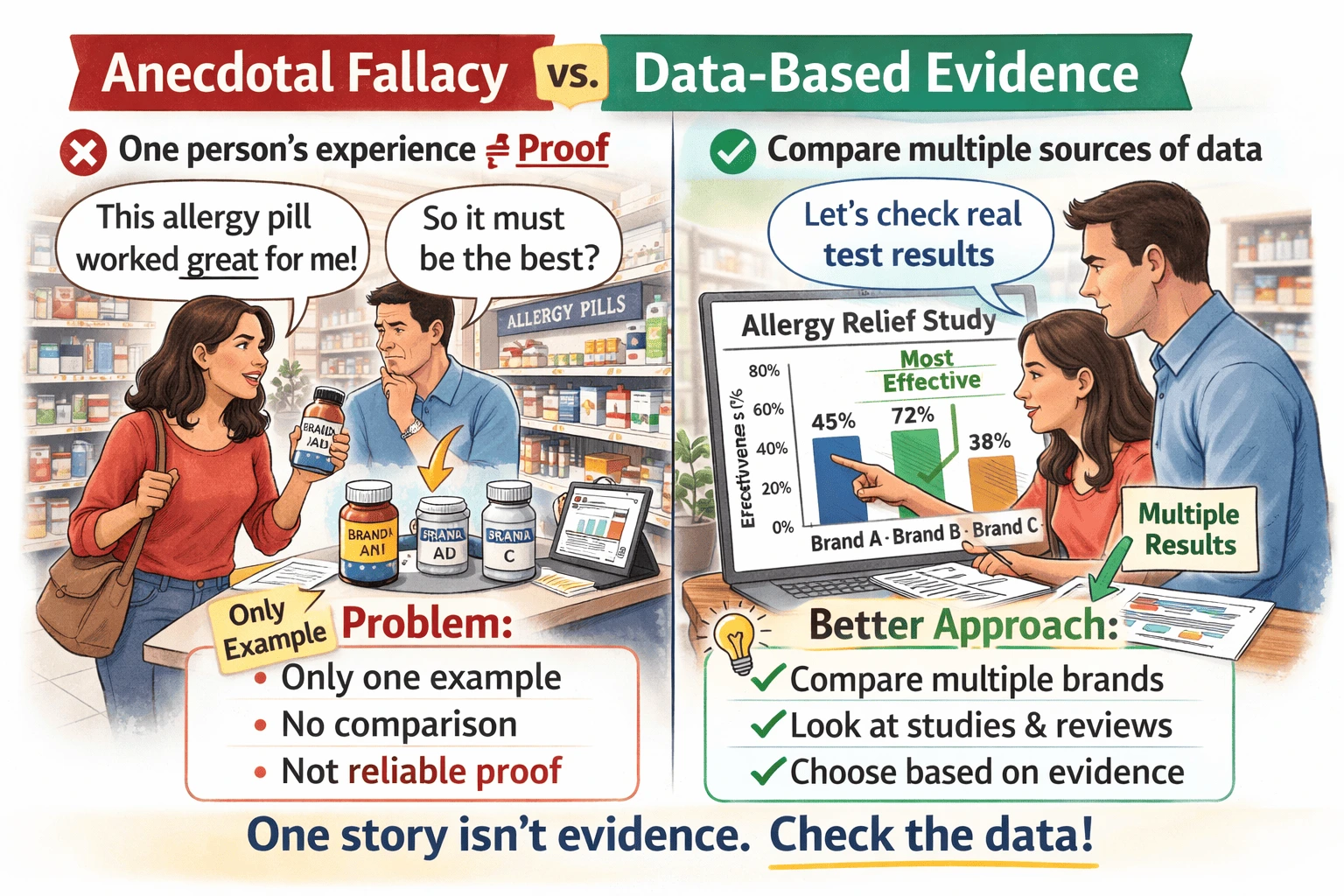
Maya and Daniel are standing in a pharmacy, trying to choose an allergy medicine.
Maya picks up one box and says:
“This one is amazing. I used it last year and it worked great for me.”
That sounds reassuring. It’s a real experience. It’s honest.
Daniel looks at the shelf—there are several brands. He pauses and says:
“Okay, but that’s just one experience. Let’s check how these compare overall.”
They look up a comparison chart and a study that tested the medicines across many people. The results show that another brand works better for most users.
Maya’s story wasn’t useless—but it wasn’t proof either.
Choosing based only on “it worked for me” would mean treating one story as enough evidence.
That’s the anecdotal fallacy in its natural habitat.
Why Stories Beat Statistics in Your Brain
Here’s the uncomfortable truth: your brain is built to prefer stories over spreadsheets. Several well-documented mental quirks stack the deck.
Vividness. A story has a face, a name, and details. “My neighbor’s rash cleared up in two days” paints a picture. “The treatment showed modest improvement across 4,000 patients” paints… nothing. Vivid information is easier to remember and easier to believe, so it feels more true than it is.
The identifiable-victim effect. Psychologists have repeatedly found that people respond far more strongly to one identified person than to statistics about thousands. A single named child in need moves us more than a mortality table ever could. One person is a story we can feel; a thousand people are an abstraction.
The availability heuristic. Your brain judges how likely something is by how easily an example comes to mind. A dramatic story you heard yesterday is instantly available; a dataset you skimmed once is not. That shortcut is the availability heuristic, and it quietly converts “memorable” into “probable.”
Narrative transportation. When you’re absorbed in a good story, research suggests you actually lower your defenses. You stop counter-arguing and start experiencing. A statistic invites scrutiny; a story invites you in.
Add confirmation bias—our habit of embracing whichever stories fit what we already believe—and the outcome is predictable:
One dramatic story beats a boring dataset almost every time. Not because it’s better evidence, but because it’s better packaged for a human brain.
Everyday Anecdotal Fallacy Examples
You’ll hear this kind of reasoning all the time:
“My uncle smoked his whole life and lived to 90, so smoking isn’t that bad.” “This app didn’t work for me, so it’s probably useless.” “My friend invested in this and lost money, so it’s a bad idea.” “I tried this diet once and hated it, so it doesn’t work.”
In each case, a single story is being used to judge a much bigger question.
Notice how close this sits to hasty generalization—jumping from a tiny sample to a sweeping rule. The anecdotal fallacy is usually step one: a single story goes in, a universal conclusion comes out.
Famous Real-World Examples
“My grandfather smoked and lived to 95”
This is the canonical anecdote, and you’ve almost certainly heard a version of it.
Here’s the thing: it’s usually true. Some lifelong smokers really do reach their 90s. But health researchers estimate that smoking kills up to half of its long-term users. The grandfather who made it to 95 isn’t evidence against the statistics—he’s the exception the statistics already account for.
There’s also a hidden filter at work: you only hear from survivors. The smokers who died at 55 aren’t at the family reunion telling their story. That’s survivorship bias doing the selecting for you—the visible story survives, while the invisible outcomes vanish.
One 95-year-old smoker doesn’t disprove the odds. He just won a bet most people lose.
Vaccine fears and the power of one story
Few examples show the gap between anecdotes and data more clearly—or more painfully.
When a parent shares a heartbreaking story about their child changing after a medical appointment, it lands with enormous emotional force. The worry behind it is real, and it deserves respect, not ridicule.
But the evidence here is unusually strong: large population studies—including one Danish study that followed more than 650,000 children—have found no link between routine childhood vaccination and autism. Part of what makes the anecdotes feel so compelling is timing. The signs of autism often become noticeable around the same age that routine vaccines are given, so the two events sit side by side in a parent’s memory. And two things happening together is not proof that one caused the other—that’s the classic correlation vs. causation trap.
Here’s the uncomfortable part: the anecdote feels stronger than the statistics. One tearful interview travels farther than any cohort study ever will. That isn’t because people are foolish—it’s because stories are simply better at reaching us. Which is exactly why this fallacy matters.
The testimonial industry
Ever wonder why ads lean so heavily on before-and-after stories?
Because testimonials work. For years, U.S. advertisers could showcase spectacular individual results next to a tiny “results not typical” disclaimer—until regulators tightened the rules in 2009, partly because the fine print did so little to blunt the story’s persuasive power.
An entire industry is built on the anecdotal fallacy. That should tell you how effective it is.
Why the Anecdotal Fallacy Is a Problem
Stories can be useful. They can highlight possibilities. They can point you toward questions worth asking.
But they can’t replace evidence.
The anecdotal fallacy:
- Ignores larger patterns and data
- Overweights unusual, dramatic, or emotional cases
- Makes bad ideas look good (and good ideas look bad)
- Turns “this happened to me” into “this is how it always is”
The issue isn’t the story. It’s treating the story like proof.
Anecdotes vs. Data: When Stories Are Actually Useful
Let’s be fair to stories, because this part gets lost: anecdotal evidence isn’t worthless. It’s just limited.
Stories are genuinely good at three things:
Generating hypotheses. Plenty of discoveries begin with “that’s odd…” A doctor notices one unusual recovery; researchers then design a proper study to test it. The anecdote asks the question. The data answers it.
Illustrating mechanisms. A story can walk you through how something plays out in one real life, step by step—something no summary table can do.
Humanizing data. “Twelve percent of patients improved” becomes real when you meet one of them. A good story helps true statistics stick.
What stories can never do is establish rates. How often does this happen? For how many people? Compared to what alternative? A single story has no denominator. It can show you that something can happen—never how likely it is.
A good rule: Stories suggest. Evidence decides.
How to Spot (and Avoid) It
When you hear:
“It worked for me…” “It didn’t work for my friend…” “I know someone who tried this…”
Pause and ask:
“Okay—but what does the broader evidence say?”
And turn the question inward, too. The version of this fallacy you’re most likely to miss is your own—the one experience you keep citing because it happened to you. Being your own fact-checker is harder than checking other people, and far more valuable.
Personal experiences can start a conversation. They shouldn’t end it.
How to Respond
You don’t have to be rude about it. The goal is to honor the story while asking for the data. Try one of these:
“That’s a real experience, and I’m not dismissing it—but one case can’t show us the overall pattern. Is there broader data on this?”
“It clearly worked for you. Before I try it, I’d want to know: does it work for most people, or were you one of the lucky ones?”
“That’s exactly the kind of story worth checking against a bigger sample. Let’s see what the studies found.”
Notice what each response does: it acknowledges the person, separates the story from the conclusion, and politely asks for a denominator. No hostility required.
Spotting anecdotal reasoning gets dramatically easier with practice. Test yourself with our logical fallacy quiz, where anecdotes hide among solid arguments—or argue it out with a character who runs on personal stories in People You Meet.
The Takeaway
The anecdotal fallacy happens when we replace data with a single story.
Stories are powerful. They’re memorable. They’re human. Your brain will always reach for them first—that’s not a flaw you can delete, only one you can catch in the act.
So keep telling stories. Keep enjoying them. Just don’t let one story make your decisions alone.
Don’t ask only, “Who did this work for?” Ask, “What happens for most people?”