
Why it fails.
You’ve probably done this.
You try a new place, app, or service. It goes badly. Something breaks. The timing is off. You leave annoyed.
Later, you hear yourself say:
“That place is bad.”
Not that day was bad. Not my experience was bad. Just… that place is bad.
That’s the hasty generalization fallacy in action—jumping to conclusions from a sample far too small to carry them.
What Is the Hasty Generalization Fallacy?
The hasty generalization fallacy is a logical fallacy where someone draws a broad conclusion from a sample that is too small or too unrepresentative to support it. It turns “this happened once or twice” into “this is how it always is.”
In simple terms: You see a little, and you conclude a lot.
The same mistake travels under other names—overgeneralization, sweeping generalization, jumping to conclusions. Whatever you call it, the structure is identical: a big claim balancing on a tiny base of evidence.
A Simple, Real-Life Example
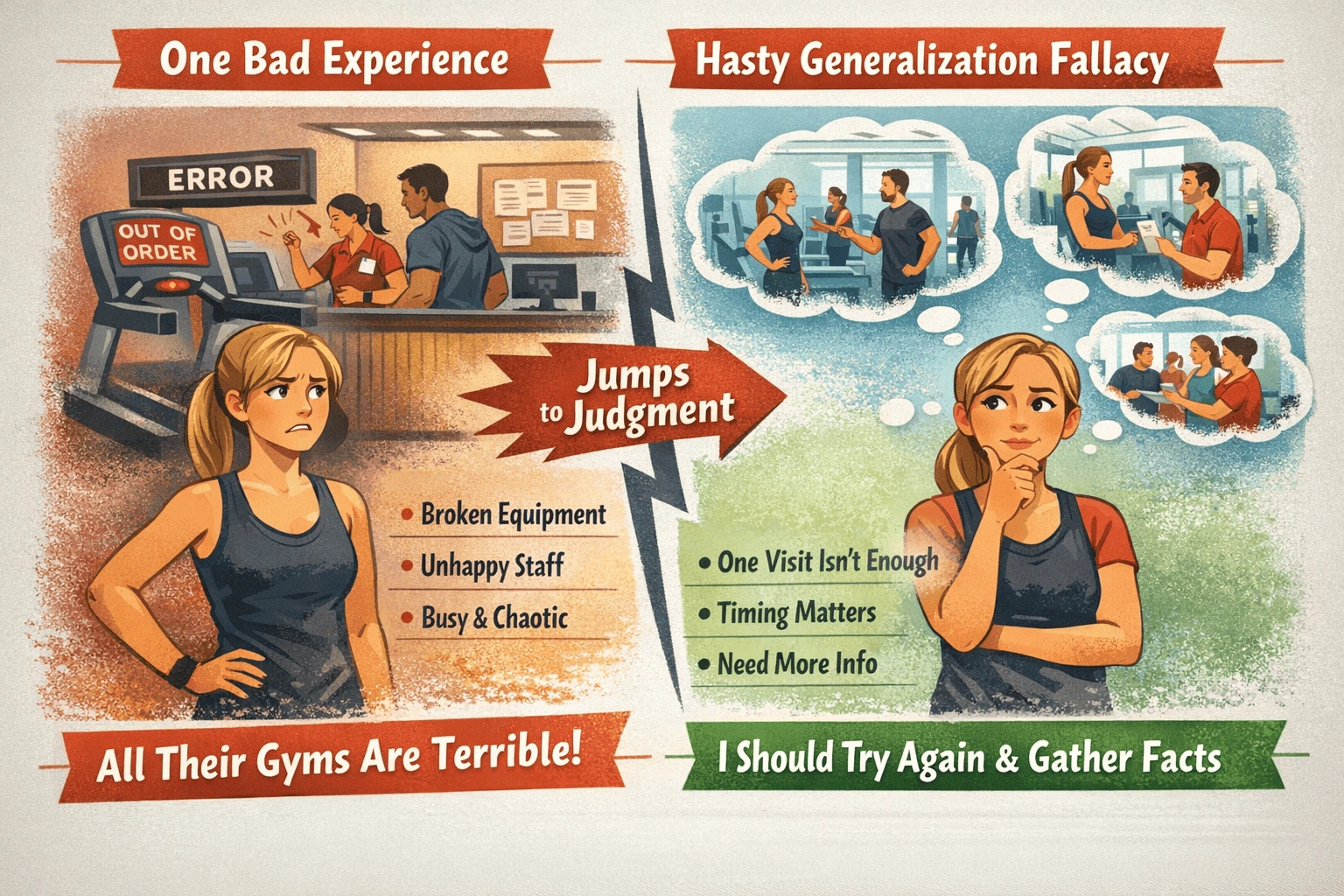
Emma wanted to change gyms. A friend suggested a popular chain that had just opened nearby.
She went after work on a busy day. The front desk was overwhelmed. A trainer looked distracted. One treadmill kept failing.
That night, she said:
“I’m not joining that chain. Their gyms are badly managed.”
A few weeks later, she heard coworkers say the same gym was smooth and well-run, especially in the mornings. The opening weeks, it turned out, had just been chaotic.
Emma hadn’t judged the gym. She had judged everything based on one visit—and not even a typical one.
Why Our Brain Does This
Your brain likes shortcuts. It wants quick rules like:
“Don’t go there.” “Don’t try that again.”
That feels efficient—and for most of human history, it was. If one berry made you sick, skipping every similar berry was a smart trade.
But modern questions are rarely that simple, and two mental habits make the shortcut misfire:
Memorable beats typical. Dramatic experiences come to mind more easily than ordinary ones, so they feel more common than they really are. That’s the availability heuristic at work.
First verdicts defend themselves. Once you’ve decided “that place is bad,” confirmation bias starts filtering everything new to protect the verdict.
The result: one or two experiences quietly harden into a lifelong rule. Weak evidence pretending to be a strong conclusion.
The Sample-Size Problem, Explained Simply
Here’s the cleanest way to see why small samples lie.
Flip a fair coin three times. There’s a one-in-eight chance you get three heads in a row—not rare at all. Would you conclude the coin only lands heads?
Obviously not. Three flips prove nothing. Streaks are guaranteed to appear in small samples; they’re noise, not signal. (Misreading streaks in the opposite direction—“tails is due next!”—is its own famous error, the gambler’s fallacy.)
Yet we make the three-flips mistake with everything else. Two rude waiters. Three failed attempts. One crashed app. Tiny samples, confident verdicts.
And a small sample isn’t even the worst problem. A biased sample is.
- Selection effects. How your examples reached you matters as much as how many you have. Angry customers write reviews; satisfied ones stay quiet. You didn’t sample “customers”—you sampled “customers annoyed enough to type.”
- Survivorship. Sometimes you only ever see the cases that made it through a filter. Study only successful startups and you’ll “learn” that dropping out of college works—because the dropouts who failed never made the news. That’s survivorship bias, and it can make even a huge sample worthless.
Small samples mislead by accident. Skewed samples mislead by design.
Everyday Hasty Generalization Examples
“This app crashed once. It’s unreliable.” “I met two rude people from there. People there are rude.” “My first attempt failed. This doesn’t work.”
Notice the jump: from one case to always.
And when the sample is a single personal story—“it worked for me!”—hasty generalization overlaps with its close cousin, the anecdotal fallacy: one vivid experience standing in for actual data.
Famous Real-World Examples
The 1936 Literary Digest poll
The most famous polling disaster in history proves a counterintuitive point: a massive sample can still be a terrible sample.
In 1936, Literary Digest magazine ran the biggest election poll ever attempted. It mailed out around ten million ballots and received roughly 2.4 million responses—a staggering number, even by today’s standards. The verdict: Alf Landon would comfortably beat Franklin D. Roosevelt.
Roosevelt won 46 of 48 states, one of the largest landslides in American history.
What went wrong? The magazine drew its mailing lists from sources like telephone directories, automobile registrations, and its own subscriber rolls. In the depths of the Great Depression, people with telephones, cars, and magazine subscriptions skewed wealthier than the average voter—and leaned away from Roosevelt. On top of that, the minority who bothered to mail their ballots back weren’t typical of everyone who received one.
Meanwhile, George Gallup called the election correctly using a dramatically smaller—but far more representative—sample. Representativeness beat raw size, and it wasn’t close. The humiliated Digest folded within two years.
Two-point-four million data points. One wrong conclusion. Sample quality beats sample quantity.
First impressions in hiring
Research on job interviews has repeatedly found that interviewers form impressions within the first few minutes of meeting a candidate—and that those early snap judgments color how they interpret everything that follows.
That’s hasty generalization running on a loop: a tiny, unrepresentative sample of a person (their most nervous five minutes) gets generalized into conclusions about competence, character, and future performance. It’s one reason many organizations have shifted toward structured interviews and work-sample tests—formats deliberately designed to collect a bigger, fairer sample of what a candidate can actually do.
New Coke and the sip test
In 1985, Coca-Cola reformulated its flagship drink after blind taste tests involving roughly 200,000 people favored the new, sweeter recipe. Within about three months of launch, public backlash forced the company to bring the original formula back.
The tests weren’t fake—they were unrepresentative. A small sip in a testing booth isn’t how anyone actually drinks a cola. Sweetness can win a sip and lose a whole can, and no taste test captures what a familiar brand means to loyal drinkers. The company generalized from the wrong situation to the real one.
Why Hasty Generalization Is a Problem
Hasty generalization:
- Pushes you away from good options for weak reasons
- Turns temporary problems into permanent labels
- Makes you confident on very little evidence
- Feeds stereotypes—the ugliest generalizations about groups of people are built exactly this way
It feels decisive. It often isn’t accurate.
Generalization Done Right
Here’s the twist: generalizing isn’t the fallacy. You couldn’t get through a day without it. Every lesson you’ve ever learned is a generalization. Science itself is careful, disciplined generalization.
The fallacy is generalizing from garbage. So what makes a sample good enough?
Size relative to variability. How many examples you need depends on how much the thing varies. To learn whether a stove burns, one touch is plenty—stoves are consistent. To judge a restaurant, one visit isn’t—restaurants have good nights and bad ones. The more variable the thing, the more evidence you need.
Representativeness. Your sample should look like the whole it stands for: weekday mornings and Saturday nights, new customers and longtime ones. If you only sampled one slice, you’re only entitled to conclusions about that slice.
Random selection. The gold standard. When every member of a group has an equal chance of being included, hidden biases can’t quietly rig the outcome. It’s the difference between Gallup’s small-but-representative poll and the Digest’s enormous-but-skewed one.
One more warning: don’t gather your examples after choosing your conclusion. Cherry-picking the cases that fit the pattern you want is its own fallacy—the Texas sharpshooter.
The honest habit sounds like this: “Based on the little I’ve seen, maybe this is a pattern. Let me see more before I’m sure.”
How to Avoid It
When you catch yourself thinking:
“This always happens.” “They’re all like that.”
Ask one question:
“How much evidence do I actually have?”
If the answer is “not much,” you’re probably looking at hasty generalization, not a real pattern.
How to Respond
When someone hands you a sweeping generalization, you don’t need to call them irrational. Just ask about the sample—gently:
“That might be true—but how many times have you actually seen it? I want to make sure it’s a pattern and not a one-off.”
“Fair enough, that was your experience. Do we know if it’s typical? We might have caught it on a bad day.”
“‘Always’ is a big word. Would a couple of counterexamples change your mind?”
Each response accepts the experience while questioning the leap—which keeps the conversation open instead of turning it into a fight. It’s also exactly how you’d want to be corrected.
The fastest way to stop overgeneralizing is repetition—spotting the leap until it becomes automatic. Test yourself with our logical fallacy quiz, where hasty generalizations hide among reasonable arguments, or work through a daily news story until “wait, how big was the sample?” becomes a reflex.
The Takeaway
The hasty generalization fallacy is what happens when we confuse a moment with a pattern.
Bad days happen. Timing matters. One experience is not the whole story—and as the Literary Digest learned, even 2.4 million skewed responses aren’t either.
Better thinking starts when you stop turning:
“This went badly once”
into:
“This is how it always is.”