
Why it fails.
 You’ve heard this argument before.
Someone makes a claim. There isn’t much evidence. But then they add:
“A famous expert said this, so it must be true.”
And suddenly, the conversation feels… over.
No one asks why it’s true. No one checks what the evidence is. The name does all the work.
That’s the appeal to authority fallacy—also called the argument from authority—and it may be the most misunderstood of all the common arguments and fallacies. Because sometimes trusting an expert is exactly the right move. And sometimes it’s just borrowed confidence in a lab coat.
Let’s sort out which is which.
What Is the Appeal to Authority Fallacy?
The appeal to authority fallacy treats a claim as true because an authority figure said it—rather than because the evidence supports it. The reputation replaces the reasons.
In simple terms: “Trust this, because someone important said so.”
Logicians have had a name for this move for centuries: argumentum ad verecundiam—literally, “argument from reverence.” You’re not being shown proof. You’re being asked to bow.
If you’re working through the full list of logical fallacies, this one shows up constantly—in ads, social media, politics, health advice, and even at work.
But here’s what makes it trickier than most fallacies: expert opinion often is good evidence. The fallacy isn’t “listening to experts.” It’s letting a name do the work that evidence should be doing. We’ll draw that line precisely in a moment.
A Simple, Real-Life Story
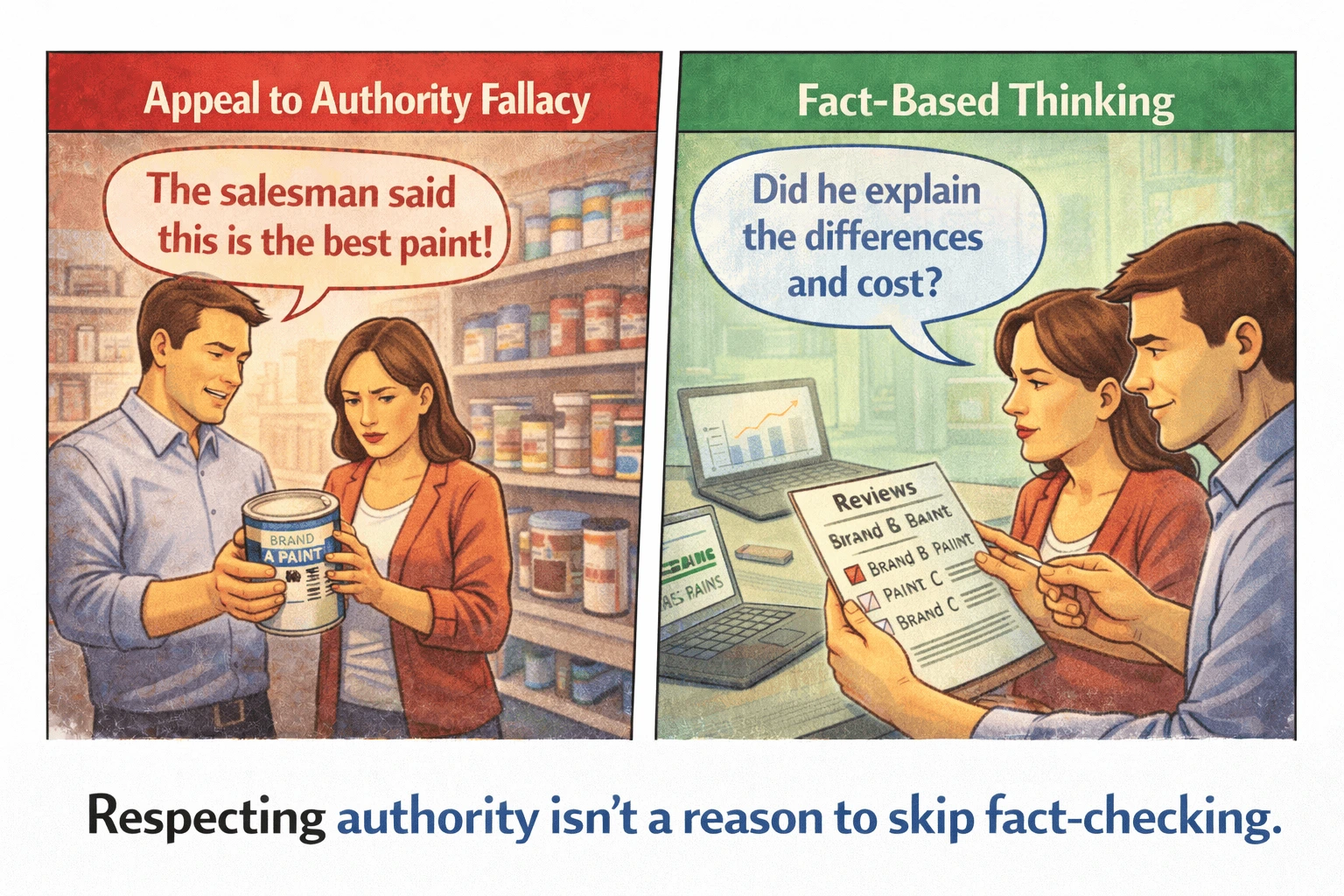
Emma and Leo are at a hardware store, trying to choose paint for their living room.
They’re standing in front of a shelf full of options when a salesman walks over, picks up one can, and says:
“This is the best paint we have. Everyone buys this one.”
Leo looks relieved and says:
“Great, let’s just take this.”
Emma hesitates.
“Did he explain why it’s better? Or how it compares to the others?”
They start looking at reviews, checking durability, finish, and price. A few minutes later, they realize another brand actually fits their needs better—and costs less.
The first choice felt convincing because the salesman said so. The better choice came from looking at the reasons and the evidence.
That first impulse—trusting the claim just because an authority figure said it—is the appeal to authority fallacy in miniature.
Why Our Brain Falls for It
Because trusting authority is usually a brilliant shortcut.
You can’t personally verify everything. You haven’t run the drug trials, stress-tested the bridge, or peer-reviewed the climate models. Nobody has time for that. So we outsource—to doctors, engineers, scientists, mechanics. Dividing up the mental labor is how civilization functions at all.
The shortcut turns into a fallacy when:
- The “authority” isn’t actually an expert in that field
- One person’s opinion is treated as proof, not as one input
- The evidence behind the opinion is never checked at all
- The name is used to end the conversation instead of inform it
There’s a psychological quirk underneath this called the halo effect: success in one area glows onto everything else a person touches. A brilliant physicist feels like they must be right about economics too. They aren’t—at least, not because of the physics.
And we’re most vulnerable when the “expert” tells us what we already wanted to hear. That’s this fallacy teaming up with confirmation bias—a fallacy and a bias running the same con from both ends.
You’ll often see it next to other argument fallacies too, like the bandwagon fallacy (“everyone believes this”) or ad hominem (“don’t listen to him—look who’s talking”). Different tricks. Same result: less thinking, more following.
Everyday Appeal to Authority Examples
You’ll hear this kind of reasoning everywhere:
“A celebrity says this supplement works, so it must be good.”
“A famous entrepreneur believes this, so it has to be right.”
“This expert said it on TV, so the debate is settled.”
“Who are you to disagree? They’re a professor.”
“Studies show it works.” (Which studies? Run by whom? Showing what, exactly?)
In each case, the person is doing the work that evidence should be doing.
Notice that last one—the vague version. No name, no source, just the aroma of expertise. It’s arguably the sneakiest form of the argument from authority, because there’s nothing specific enough to check.
Legitimate Authority vs. Fallacious Appeals
Here’s the nuance most explanations skip: citing a relevant expert is often good reasoning.
If the overwhelming majority of oncologists agree about a treatment, that consensus is real evidence—because it summarizes thousands of studies you’ll never read yourself. Deferring to it isn’t lazy. It’s rational.
The fallacy sneaks in through four specific doors:
- Wrong field. A celebrity endorsing supplements. A physicist opining on economics. Expertise doesn’t transfer.
- Lone voice against consensus. “This one doctor disagrees with all the others” is a reason for curiosity, not a trump card.
- Vague authority. “Experts say…” and “studies show…” with no names and no sources. If you can’t check it, it isn’t evidence yet.
- Conversation-stopper. Credentials used to end debate (“She has a PhD, so drop it”) rather than to inform it.
| Legitimate appeal | Fallacious appeal | | --- | --- | | Expert speaking within their field | Famous name speaking outside their field | | Reflects the consensus of many experts | Cherry-picks a lone dissenter | | Names the source so you can verify it | “Experts say…”—no name, no source | | Expertise treated as strong evidence, still open to question | Credentials treated as final proof | | The expert can explain the reasoning | The name is the argument |
Quick test: swap the authority’s name for a stranger’s. If the argument still stands on its evidence, it was never leaning on the name. If it collapses, you’ve found the fallacy.
Famous Real-World Examples
“More doctors smoke Camels”
From the 1930s into the early 1950s, American cigarette ads regularly featured physicians. The most famous campaign, launched by R.J. Reynolds in 1946, claimed that “more doctors smoke Camels than any other cigarette”—based on surveys conducted by the company’s own advertising agency, sometimes right after handing doctors free cartons of Camels.
The white coat did the persuading. The medical evidence, as it accumulated, pointed the opposite way—and by 1964, the U.S. Surgeon General’s report officially linked smoking to lung cancer.
The lesson: authority imagery can be manufactured. “Doctors prefer it” was never evidence about health. It was marketing wearing a stethoscope.
Linus Pauling and megadose vitamin C
Linus Pauling won two Nobel Prizes—Chemistry in 1954 and Peace in 1962—and ranks among the most brilliant scientists of the twentieth century. Starting in 1970, he publicly championed large doses of vitamin C, first to prevent colds and later as a therapy for cancer.
Rigorous clinical trials, including randomized studies at the Mayo Clinic, failed to support those claims. Vitamin C sales soared anyway, because “a two-time Nobel laureate says it works” felt like proof.
It wasn’t. His prizes were in chemistry and peace—not medicine. Genuine, spectacular expertise in one field doesn’t validate claims in another, and even a great scientist doesn’t outvote the clinical evidence.
Why It’s a Problem
An appeal to authority doesn’t mean the claim is false. It means the reason given for believing it is weak.
Relying on it:
- Lets bad ideas hide behind big names
- Makes people stop asking for evidence
- Confuses “someone important believes this” with “this is true”
- Turns discussions into status contests instead of evidence checks
It also cuts both ways. Once names replace reasons, whoever quotes the most impressive person “wins”—and truth stops being the point. It’s the same failure you see in the appeal to tradition: outsourcing the thinking to something other than evidence, whether that’s the past or a podium.
When It’s NOT a Fallacy
Let’s be precise, because this fallacy gets over-called constantly.
It is not fallacious to defer to expert consensus in the expert’s own field. Trusting your cardiologist about your heart, structural engineers about bridges, or the broad agreement of climate scientists about climate isn’t a reasoning error. It’s the rational response to a world too big to verify alone.
Expert opinion is strong but defeasible evidence: it should raise your confidence, and it should still bend to better evidence.
Three questions separate healthy deference from blind faith:
- Is this their actual field?
- Do most qualified experts agree?
- Could I check the reasoning if I wanted to?
Three yeses: defer away. Any no: start asking questions.
Watch for the reverse mistake, too. Shouting “appeal to authority!” to wave off an entire scientific consensus is itself sloppy reasoning—and it’s a favorite move in misinformation, where “do your own research” really means “ignore everyone in a position to know.”
How to Spot (and Avoid) It
When you hear:
“An expert said this…” “A famous person believes this…” “This authority agrees with me…”
Ask one simple question:
“Okay—but what’s the evidence?”
Then run a quick checklist:
- Name the source. Anonymous experts don’t count.
- Check the field. Fame in one area isn’t knowledge in another.
- Check the consensus. One dissenting authority isn’t a debate-winner.
- Remove the name. A strong argument should still make sense even if you don’t know who said it.
Good authorities can point you toward good reasons. They can’t replace good reasons.
How to Respond
You don’t need to be combative. Try one of these:
“They might well be right—do you know what evidence they based that on?”
“Is this actually their field? Being brilliant at one thing doesn’t automatically make someone right about another.”
“What do most experts in this area say? If this is one voice against the consensus, I’d want to know what the rest have found.”
Each response does the same quiet work: it moves the spotlight from the person back to the proof—without insulting anyone’s hero.
Want to make this stick? Spotting the argument from authority in the wild is a skill, and skills need reps. Test yourself with our logical fallacy quiz, then try News Detector—news coverage leans on “experts say” more than almost any other trick, and you’ll start noticing it within the first paragraph.
The Takeaway
The appeal to authority fallacy happens when we swap evidence for reputation.
Experts matter. Experience matters. Credentials matter.
But they matter because they usually track the evidence—not because they replace it.
So keep both habits.
Trust relevant experts, especially when they agree. And still ask, “Why should this be true?”—not just “Who said it?”