
Why it fails.
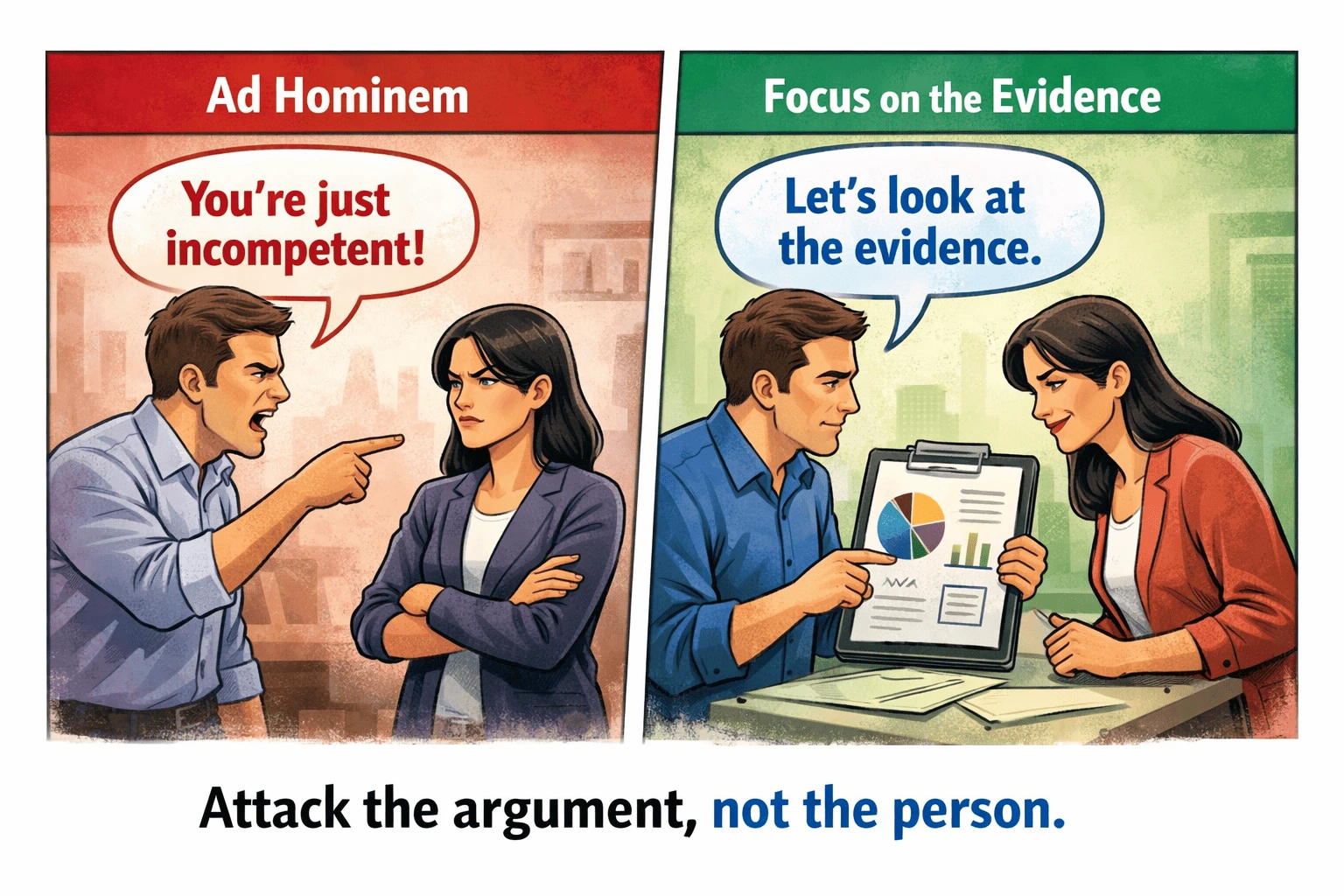
You’ve seen this happen. You’ve probably done it too.
Two people are arguing about something—work, politics, a product, a plan. One of them makes a point. The other doesn’t really answer it. Instead, they say something like:
“Why should we listen to you? You don’t even know how this works.”
And just like that, the conversation quietly changes direction.
This is the ad hominem fallacy—sometimes called the personal attack fallacy—and it might be the most common reasoning mistake in human history. Once you learn its shape, you’ll spot it in meetings, family dinners, political debates, and roughly every comment section ever created.
What Is the Ad Hominem Fallacy?
Ad hominem (Latin for “to the person”) is a logical fallacy where someone attacks the character, background, or motives of the person making an argument instead of addressing the argument itself. The attack is treated as if it disproved the claim—but a speaker’s flaws don’t make their statement false.
In simple terms, it replaces:
“Your idea is wrong because…” with “You’re wrong because you’re…”
That swap matters more than it looks. An argument is a chain of claims and evidence. Attacking the person who said it doesn’t break a single link in that chain. It just changes the subject to something juicier.
A Simple, Real-Life Story
Mark and Julia are in a team meeting discussing a new feature.
Mark says the timeline is too aggressive and suggests delaying the release by two weeks to avoid bugs.
Instead of addressing the risk, someone says:
“Of course you’d say that. You always overthink things and slow everyone down.”
The room goes quiet. The topic changes.
No one checks whether the timeline is actually risky. No one looks at the data. The focus has shifted from the plan to the person.
That’s ad hominem in action.
And here’s the uncomfortable part: Mark might be wrong. Maybe he really does overthink things. But nobody in that room will ever find out—because his argument wasn’t answered. It was buried.
Why Our Brain Loves This Shortcut
Because it’s easier. Dramatically easier.
Evaluating an argument takes effort. You have to understand the claim, weigh the evidence, and accept the possibility that you’re the one who’s wrong. Attacking the person takes about two seconds and feels fantastic.
There’s a deeper reason too. Our brains evolved to track people—who’s trustworthy, who’s a rival, who belongs to our group. Tracking abstract arguments is a much newer skill. So when a debate heats up, we instinctively slide from the hard question (“Is this true?”) to the easy one (“Do I like this person?”).
That’s why ad hominem travels in a pack with other evasive moves: the straw man fallacy, which misrepresents someone’s position, and the red herring, which changes the subject entirely. Different tricks, same goal—avoid the actual argument.
The Types of Ad Hominem
Personal attacks come in several classic flavors. Here are the five worth knowing, each with a one-line example.
1. Abusive ad hominem. The plain insult, dressed up as a rebuttal.
“You’re an idiot, so your budget plan is obviously garbage.”
2. Circumstantial ad hominem. Dismissing a claim because of the speaker’s situation or supposed motives.
“Of course the salesperson recommends the premium plan—she earns commission on it.”
3. Tu quoque (“you too”). Deflecting criticism by pointing at the speaker’s hypocrisy. It’s common enough to deserve its own article.
“Don’t lecture me about smoking, Dad—you smoked for twenty years.”
4. Guilt by association. Rejecting an idea because of who else holds it.
“You know who else supported policies like that? History’s worst people.”
5. Poisoning the well. Attacking someone’s credibility before they speak, so the audience discounts everything that follows.
“Before my opponent begins, just remember he’s a paid lobbyist.”
Five costumes, one trick: aim at the person, skip the argument.
Everyday Ad Hominem Examples
You’ll hear this kind of faulty reasoning everywhere:
“You can’t trust her opinion on fitness—she’s overweight.” “He didn’t even finish college. Why listen to him about business?” “Your argument about budgeting is pointless—you’re terrible with money anyway.” “Of course you think that. You’re just doing it for attention.”
Notice what’s missing in every single one.
Nobody responds to the claim. They only attack the person who made it.
The fitness advice might be accurate. The business insight might be sharp. We’ll never know—the conversation ended the moment the attack landed.
Famous Real-World Examples
Attacking the person instead of the argument isn’t an internet invention. It has been derailing important debates for centuries.
The US election of 1800. The contest between John Adams and Thomas Jefferson is still remembered as one of the nastiest campaigns in American history. Partisan newspapers and pamphleteers on both sides largely skipped the real policy questions—taxes, war, the size of the new government—and aimed at the men instead. Jefferson’s supporters painted Adams as a vain, power-hungry would-be monarch. Adams’s side warned that Jefferson was a godless radical whose victory would bring moral collapse. Voters were invited to judge characters, not platforms.
The tobacco industry vs. the scientists. In the mid-1900s, as research linking smoking to serious disease piled up, the tobacco industry faced an inconvenient problem: the evidence was strong. Internal industry documents, made public decades later through litigation, revealed part of the strategy—alongside manufacturing doubt about the science itself, discredit the people producing it. Researchers were painted as alarmists, zealots, and publicity-seekers. Attacking the credibility of scientists was easier than answering their data, and it helped delay public understanding for years.
The doctor nobody believed. In the 1840s, Hungarian physician Ignaz Semmelweis showed that when doctors washed their hands between autopsies and deliveries, deaths of new mothers in his clinic fell sharply. Much of the medical establishment rejected him—and the pushback was as much about the man as the evidence. He was a junior outsider in Vienna’s medical hierarchy, and he grew abrasive as he was ignored. His personality became the excuse. His evidence went untested for years, and mothers kept dying.
Why Ad Hominem Is a Problem
The personal attack doesn’t just weaken one exchange. It corrodes the whole discussion:
- It derails real conversation and replaces it with drama
- It shields weak positions from criticism—attack the critic, keep the flaw
- It turns disagreements into personal feuds
- It rewards confidence and cruelty over correctness
Here’s the principle worth memorizing: a bad argument doesn’t become good because the speaker is virtuous, and a good argument doesn’t become bad because the speaker is annoying. Ideas and people have to be judged separately—or they can’t be judged at all.
When It’s NOT a Fallacy
Now for the nuance most explanations skip: not every attack on credibility is fallacious. Sometimes the person genuinely is the issue.
The key question: what is the argument standing on?
When a claim rests on testimony, credibility is evidence. If a witness says “I saw the defendant at the scene,” the entire claim depends on that witness being reliable. Showing they’ve lied under oath before isn’t a fallacy—it’s directly relevant, because their reliability is the whole argument. Courts examine witness character for exactly this reason.
Conflicts of interest matter for expert claims. When someone argues “trust me, I’m an expert” rather than showing their work, they’re leaning on an appeal to authority—and questioning that authority’s independence is fair play. A study funded by the company it evaluates deserves extra scrutiny.
But credibility stops mattering once the evidence is on the table. If someone shows you the data and the reasoning, their character becomes irrelevant. The math doesn’t care who did it. You can check the argument yourself.
One more distinction: a plain insult isn’t automatically a fallacy. If someone calls you stubborn and rebuts your point, that’s rude—but not fallacious. The fallacy happens when the insult is offered instead of a rebuttal, as if it settled the question.
How to Spot It
Next time you’re in a debate—online or offline—run three quick checks:
Are we discussing the idea, or the person? Would this response still make sense if someone else had said the exact same thing? Did anyone actually answer the original point?
If the conversation shifted from “Is this true?” to “What’s wrong with you?”, you’re watching the personal attack fallacy unfold in real time.
How to Respond Without Escalating
Being attacked makes you want to attack back. Resist it—that only completes the derailment. Instead, calmly separate the person from the point. Three templates that work:
“That might be fair criticism of me—but it doesn’t answer the argument. What about the point itself?”
“Let’s say you’re right about me. Would that make the data wrong? Walk me through that part.”
“If someone you trusted said exactly what I just said, how would you answer them?”
Each one does the same quiet job: it declines the fight about your character and puts the original argument back on the table—visibly, for everyone watching.
The fastest way to make this stick is recognition practice—try spotting ad hominem live in the logical fallacy quiz or debate realistic characters in People You Meet.
The Takeaway
The ad hominem fallacy is attacking the speaker instead of the statement.
It feels powerful. It feels personal. It feels like winning.
But it’s really a quiet confession: I can’t answer the argument, so I’ll aim at you instead.
Strong thinkers do the opposite. They can dislike a person and still weigh that person’s argument honestly—because truth doesn’t check who’s speaking.
And once you can spot this pattern, you’ll start noticing its cousins everywhere. Browse the full list of logical fallacies and see how many you already recognize.