Survival Mode
No skips. One wrong answer ends the run. How long can you last?
“We can't prove ghosts don't exist, so they must be real.”
About Survival Mode
Survival Mode is the hard mode of fallacy practice: questions keep coming until you get one wrong, and one wrong answer ends the run. No lives, no skips, no partial credit. Your score is your streak, and the only way to grow it is to be right about every single argument the game throws at you.
Sudden death changes how you read. In a normal quiz a coin-flip guess costs you one point; here it costs you the whole run, so you learn to notice the difference between actually recognizing a fallacy and merely finding an answer plausible. That gap — between "sounds right" and "is right" — is precisely where most reasoning errors live.
How to play
- Answer each multiple-choice question to keep your run alive and your streak counting.
- One incorrect answer ends the run immediately — there are no second chances.
- Questions draw from the full fallacy pool, so long runs require broad coverage, not just the famous fallacies.
- After a run ends, review the argument that beat you, read the linked guide, and start again.
Fallacies and biases you'll train in this mode
Every round pulls from our library of reasoning errors. Read the full guides to lock in what the game teaches you:
- Slippery SlopeA chain of "and then" predictions with no evidence any link actually follows.
- Circular ReasoningThe conclusion smuggled into the premise — hard to catch because it agrees with itself.
- EquivocationOne word quietly switching meanings mid-argument. A classic run-killer.
- No True ScotsmanRedefining the group every time a counterexample shows up.
Want the complete reference? Browse all 30+ logical fallacies with definitions and examples or explore the cognitive bias guides.
Why this format works
High-stakes retrieval sharpens discrimination. When every answer is final, you stop pattern-matching on surface features ("it mentions an expert, must be appeal to authority") and start checking the actual logical structure — because near-miss fallacy pairs like straw man vs. red herring, or false cause vs. slippery slope, are exactly what ends long runs.
Streaks are also honest feedback. A 10-question quiz score can flatter you with lucky guesses; a survival streak cannot. If you consistently die at question six, you know precisely how deep your real coverage goes — and reviewing each run-ending argument turns every loss into one targeted lesson.
Frequently asked questions
- How does Survival Mode scoring work?
- Your score is your streak: the number of consecutive correct answers before your first mistake. The run ends the moment you answer incorrectly.
- Is there a time limit in Survival Mode?
- No timer — unlike Lightning Mode, Survival gives you unlimited thinking time per question. The pressure comes from permanence, not speed.
- What counts as a good survival streak?
- Clearing 10 consecutive questions puts you above most casual players; 20+ means you can reliably distinguish commonly-confused fallacy pairs like straw man vs. red herring and false cause vs. slippery slope.
- What is the best way to improve my streak?
- Review the exact argument that ended each run, read the full guide for that fallacy in our library, and pay special attention to look-alike pairs — most runs end on a fallacy the player half-knew, not one they had never seen.
Try another mode
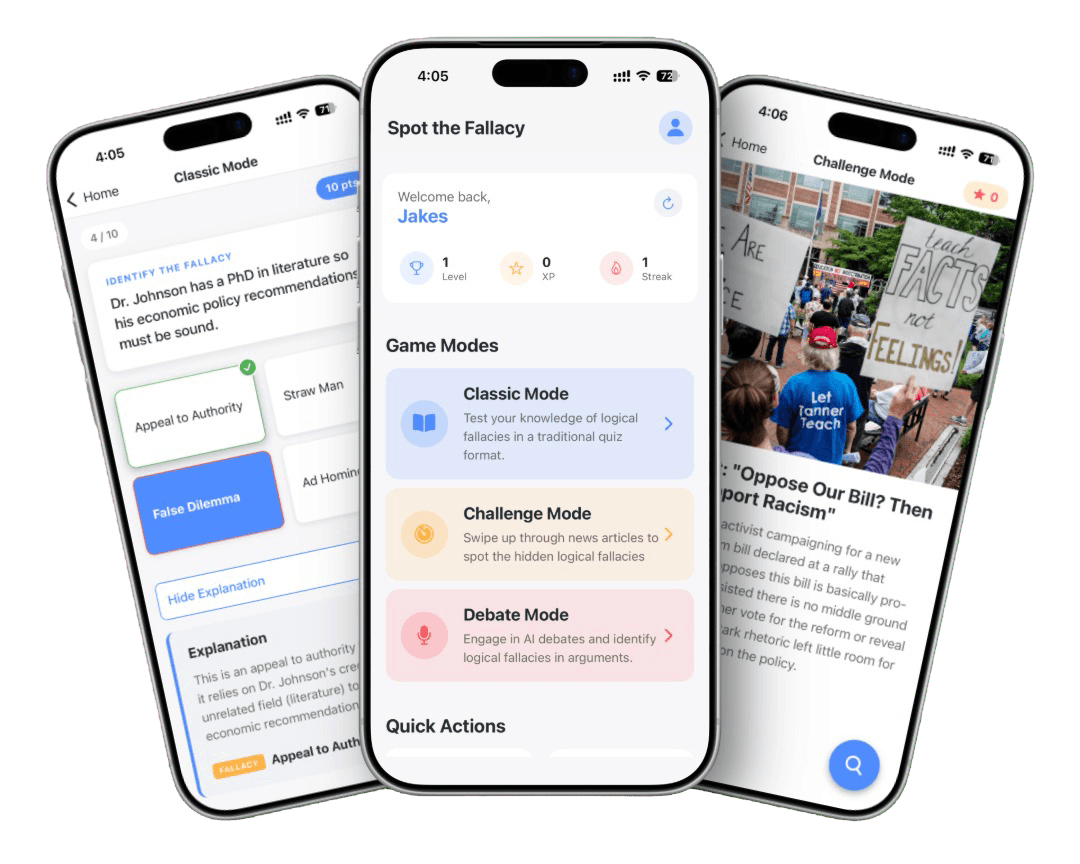
- Lightning ModeForgiving on mistakes, brutal on time: 12 seconds per argument.
- Classic TriviaWarm up here — ten questions with explanations and no sudden death.
- People You MeetFull conversations instead of single questions — spot fallacies in realistic debates.
- News DetectorHunt misinformation and flawed reasoning in realistic news stories.