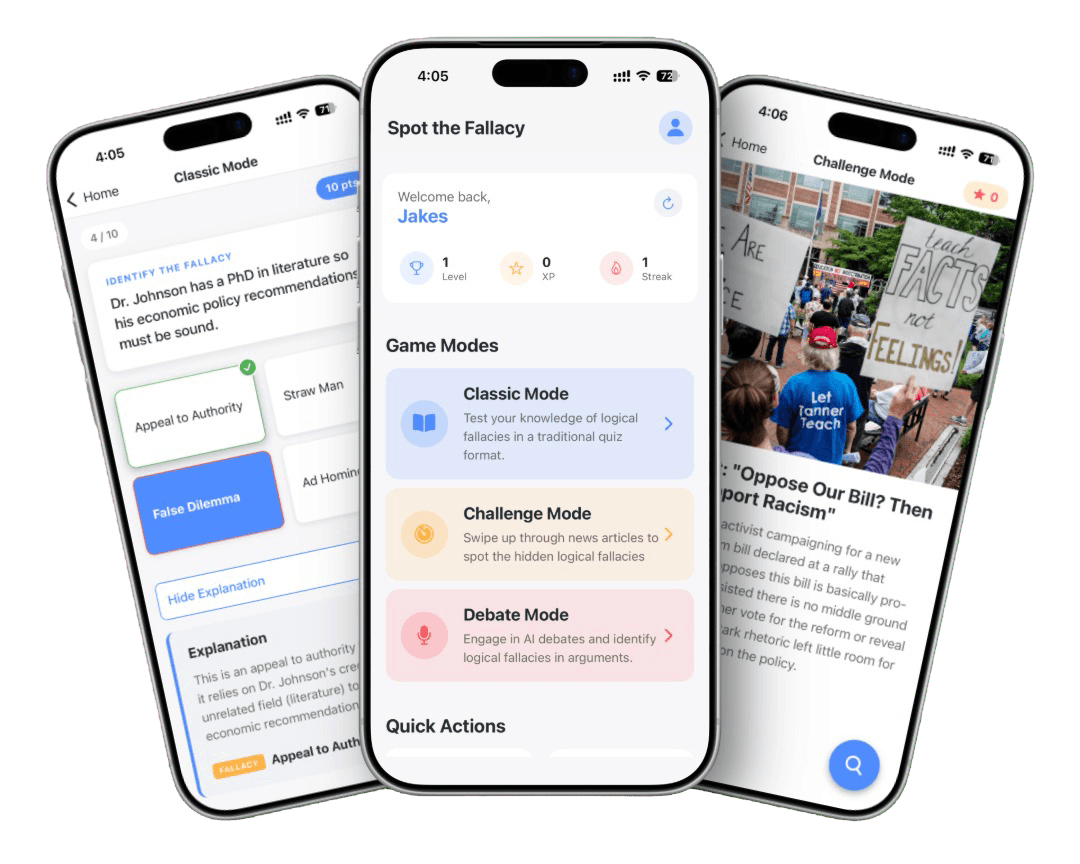
Lightning Mode
12 seconds per prompt. Speed + accuracy decides your score.
“My opponent says we should fund after-school programs. Clearly, they want to turn schools into daycare centers and make teachers babysitters.”
About Lightning Mode
Lightning Mode is a timed logical fallacy game: eight arguments, twelve seconds each, no pausing. You read a claim, feel where the reasoning bends, and commit to an answer before the timer empties. Faster correct answers earn more points, so hesitation costs you even when you are right.
The time pressure is the point. In real conversations you do not get to pull up a reference chart — a misleading argument does its work in the three seconds it takes to nod along. Lightning Mode trains the fast, intuitive layer of fallacy recognition that reading alone never builds. If the trivia quiz teaches you to identify fallacies, Lightning Mode teaches you to catch them live.
How to play
- Each argument appears with a 12-second countdown and four fallacy options.
- Answer before the timer runs out — remaining seconds convert into bonus points.
- A wrong answer or an expired timer scores zero for that question; the game moves straight on.
- Complete all eight questions to see your score and accuracy, then run it back to beat it.
Fallacies and biases you'll train in this mode
Every round pulls from our library of reasoning errors. Read the full guides to lock in what the game teaches you:
- Hasty GeneralizationSweeping conclusions from tiny samples — easy to miss at speed because it sounds like experience.
- Appeal to EmotionFeelings swapped in where evidence should be — the fallacy that works fastest on a deadline.
- Bandwagon Fallacy"Everyone’s doing it" — popularity dressed up as proof.
- False CauseTwo things happened together, so one caused the other. Twelve seconds is barely enough to check.
Want the complete reference? Browse all 30+ logical fallacies with definitions and examples or explore the cognitive bias guides.
Why this format works
Cognitive scientists distinguish fast, automatic System 1 thinking from slow, deliberate System 2 analysis. Fallacies slip past because they exploit System 1 — they feel right before you have analyzed anything. Practicing under a timer is how you push recognition down from deliberate analysis into automatic instinct.
The scoring rewards speed only when you are also correct, which mirrors the real skill: skepticism that is fast but not trigger-happy. Players typically find their accuracy dips when they first switch over from untimed trivia, then climbs past it — that crossover is the skill forming.
Frequently asked questions
- How long is one round of Lightning Mode?
- Under two minutes: eight questions with a 12-second timer each. It is designed for a quick daily rep rather than a long study session.
- What happens when the timer runs out?
- The question scores zero and the game moves to the next argument immediately. There is no penalty beyond the lost points.
- Is Lightning Mode harder than the trivia quiz?
- Same fallacy pool, higher difficulty in practice. Most players score lower on their first timed runs because the 12-second limit removes time for slow elimination — which is exactly the skill gap this mode exposes and trains.
- Why practice fallacy recognition under time pressure?
- Because misinformation works at conversation speed. A misleading claim in a reel, headline, or argument persuades in seconds — recognizing the pattern that fast is a different skill from identifying it with unlimited time, and it only develops with timed practice.
Try another mode
- Survival ModeNo timer — but one mistake ends the run. Accuracy over speed.
- Classic TriviaThe untimed version: ten questions with room to think and full explanations.
- Tweet FinderScan social media posts for flawed reasoning — swipe-speed skepticism.
- News DetectorApply your speed to realistic headlines and news-style stories.