
Why it fails.
You’ve probably been in this conversation.
You say something careful. Reasonable. Maybe even boring.
And the other person responds to… something you didn’t actually say.
Suddenly, you’re defending a position you never took.
That’s the straw man fallacy at work. It’s one of the most common reasoning failures in everyday arguments—and once you learn its shape, you’ll notice it in politics, meetings, group chats, and nearly every online thread that goes off the rails.
What Is the Straw Man Fallacy?
The straw man fallacy is misrepresenting someone’s argument—making it more extreme, simpler, or sillier than it really is—and then attacking that distorted version instead of the real one. The name fits perfectly: rather than fight the actual opponent, you build a scarecrow, knock it down, and declare victory.
In short: They don’t fight your argument. They fight a fake, easier version of it.
A strawman argument can be a deliberate debate tactic or an honest misunderstanding. Either way, the result is identical: the real point never gets addressed.
A Simple, Real-Life Story
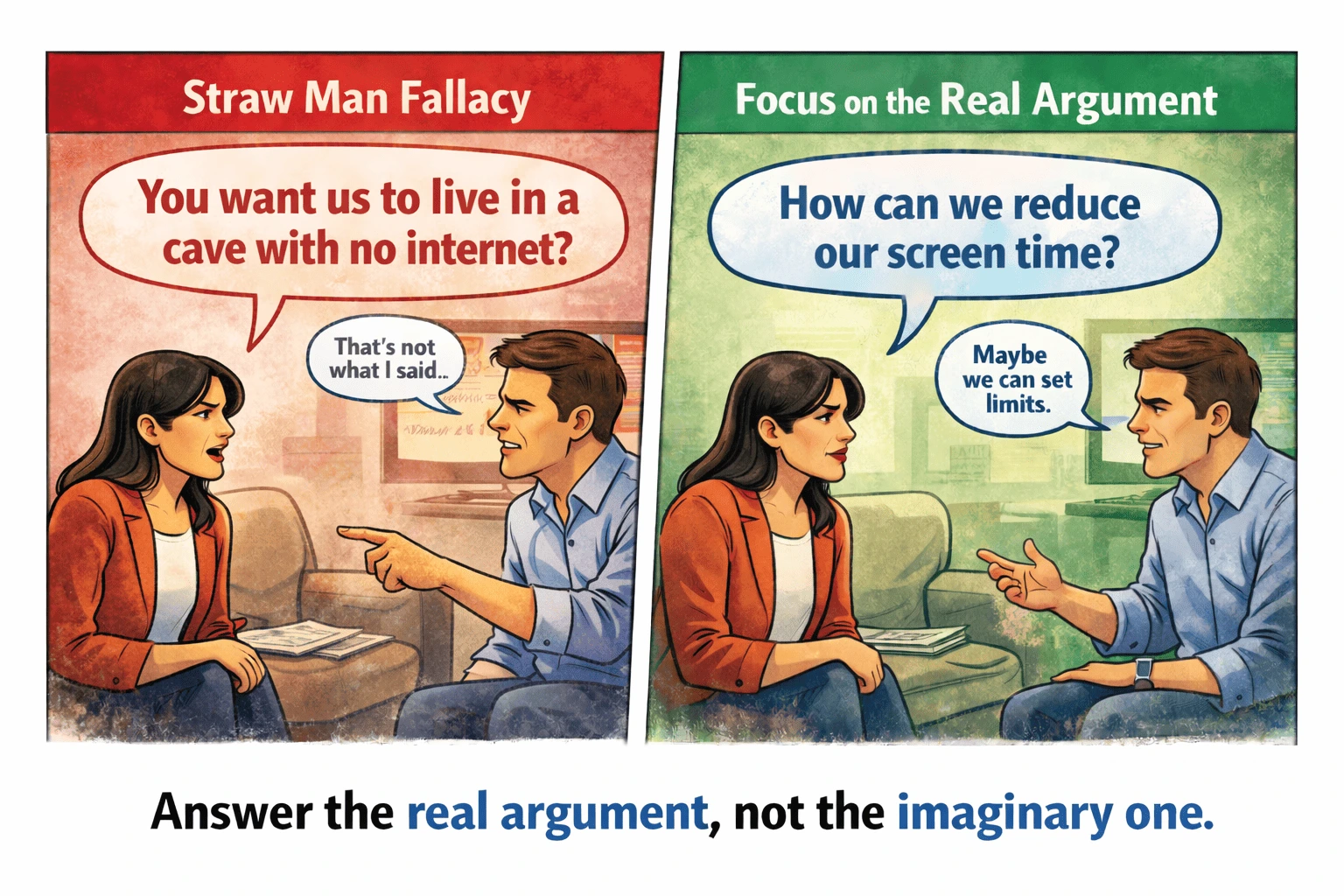
Emma and Leo are talking at home about how much time they spend on their phones.
Emma says:
“I think we’re spending a bit too much time on screens. Maybe we should try to reduce it a little.”
Leo immediately responds:
“So you want us to live in a cave with no internet and no technology at all?”
Emma looks frustrated.
“That’s not what I said. I just meant we could set some limits.”
See what happened?
Emma suggested a small, reasonable change: slightly less screen time. Leo replaced it with an extreme position: abandoning technology entirely.
Now the discussion isn’t about healthy limits anymore. It’s about defending a position Emma never took. If she’s not careful, she’ll spend the next ten minutes explaining that she doesn’t hate the internet—while her actual suggestion dies quietly in the background.
That’s the real cost of misrepresenting arguments: the genuine idea never gets a hearing.
Why People Reach for This Trick
Because distorted arguments are easier to beat than real ones.
It’s much simpler to attack:
- An extreme version of someone’s view
- An oversimplified version of their point
- A version that sounds unreasonable or silly
There’s a psychological angle too. In a heated moment, your brain often doesn’t hear the other person’s actual sentence—it hears the threat category the sentence seems to belong to. “Less screen time” gets filed under “they want to control me,” and you respond to the label instead of the words. This is why people frequently straw-man without realizing they’re doing it.
And the move rarely travels alone. You’ll see it working alongside ad hominem (attacking the person instead of the point) and the red herring (changing the subject entirely). All three dodge the same enemy: the actual argument.
The Types of Straw Man Arguments
Straw men come in a few recognizable builds. Here are the four you’ll meet most often.
1. Exaggeration. Stretching a moderate claim into its most extreme form.
“We should reduce sugar in school lunches” becomes “You want to ban every food kids enjoy.”
2. Oversimplification. Flattening a nuanced position until it sounds naive.
“Rehabilitation should be part of criminal justice” becomes “You just want to let criminals walk free.”
3. Quoting out of context. Using someone’s real words—minus the context that gave them meaning.
A review saying “this would be a great movie if you cut every scene with dialogue” becomes a poster quote: “…a great movie!”
4. The weak man (nut-picking). Attacking the worst version of an opposing side—the least informed supporter, the most extreme fringe—as if it represented everyone.
“Someone online defended that idea for a ridiculous reason, so everyone who holds it is ridiculous.”
The first three distort what was said. The fourth distorts who you’re arguing with. All four let you win a fight that never actually happened.
Everyday Straw Man Examples
You’ll hear these everywhere:
“I think we should reduce sugar in school lunches.” → “So you want to ban all tasty food?”
“We should add some rules to this process.” → “Wow, you want to control everything.”
“I’m not convinced this is the best approach.” → “So you think we should do nothing at all?”
“Maybe we should wait for more data.” → “You’re always against progress.”
In each case, a moderate, specific point becomes an extreme, easy-to-attack version. Once you start looking, you’ll find logical fallacies in real life constantly—and straw men lead the list.
Famous Real-World Examples
The straw man fallacy has shaped some of history’s biggest public debates.
“Darwin said we come from monkeys.” Charles Darwin never claimed humans descended from modern monkeys. Evolutionary theory says humans and other primates share a common ancestor—a different and more careful claim. But the monkey version was simpler, funnier, and far easier to ridicule, so it became the standard attack. At the famous 1860 Oxford evolution debate, according to accounts published afterward, Bishop Samuel Wilberforce mockingly asked biologist Thomas Huxley whether he claimed ape ancestry through his grandmother or his grandfather. More than a century and a half later, the same caricature still circulates. A well-built straw man can outlive everyone involved.
The eternal budget debate. In politics, spending proposals almost never get debated as stated. Propose slowing the growth of a program, and campaign ads will soon claim you want to “abandon our seniors” or “gut our schools.” This pattern has repeated across decades of campaigns, on every side of politics. Notice the structure: “spend less than planned” is debatable—reasonable people can weigh it. “Abandon grandma” is monstrous. So the monstrous version gets attacked instead, and the actual budget question goes undiscussed.
The Luddites. Today, “Luddite” means someone who foolishly fears all technology. The historical Luddites—English textile workers in the early 1810s—were making a narrower argument: they protested the way machines were being used to slash wages and skilled work, not the existence of machines themselves. The simplified “they hated technology” story stuck because it was easier to dismiss. An entire movement got straw-manned by history, and the caricature became the dictionary definition.
Why the Straw Man Fallacy Is a Problem
Strawman arguments do real damage:
- They waste time on positions nobody actually holds
- They make agreement impossible—you can’t resolve a disagreement you’re not really having
- They escalate conflict, because being misrepresented feels insulting
- They reward exaggeration over understanding
- And they let bad ideas survive, because the strongest criticism never gets heard
That last point is subtle but important. If you only ever defeat the weakest version of the other side, your own position never gets tested. You feel sharp while staying wrong.
When It’s NOT a Straw Man
Here’s the nuance most explanations miss: not every unwelcome summary is a straw man.
An accurate summary isn’t a distortion—even if the speaker hates it. If a plan genuinely implies spending cuts, saying “this cuts spending” is fair, no matter how loudly the speaker objects. People sometimes cry “straw man!” to dodge criticism that is, in fact, on target. That protest deserves scrutiny too.
Following an argument to its logical conclusion is legitimate. “If we accept your rule, it also applies to X—which you agree is absurd” isn’t a straw man. It’s a reductio ad absurdum, one of the oldest honest moves in logic. The difference: a reductio uses implications that actually follow from the claim. A straw man invents implications that don’t.
Simplifying isn’t straw-manning—if the strength survives. Every summary compresses. The test isn’t “did you shorten my argument?” It’s “would a neutral observer call the short version fair?”
The gold-standard habit here is steel-manning: before criticizing a position, state it so accurately that its holder would say, “Yes—exactly.” It’s a core skill of critical thinking, and it wins more real arguments than any rhetorical trick ever will.
How to Spot a Straw Man
Listen for the warning phrases:
“So you’re saying…” “What you really mean is…” “Basically, you want to…”
Then run the check:
Did they repeat your point fairly? Or did your position come back bigger, dumber, or more extreme than when you said it?
If “reduce” became “ban,” if “some” became “all,” if “rethink” became “destroy”—you’re looking at a scarecrow.
How to Respond Without Escalating
The instinct is to snap “that’s not what I said!” and repeat yourself, louder. There’s a calmer approach that works far better. Three templates:
“That’s not quite my position. Here’s what I’m actually saying, in one sentence: [restate it]. Can you respond to that version?”
“Before we continue—can you say my point back to me the way you heard it? I want to make sure we’re disagreeing about the same thing.”
“I’m not arguing for [the extreme version]. I’m arguing for [the moderate version]. Which part of that do you disagree with?”
Each template declines the fake fight and reissues the real invitation. Done calmly, it also makes the distortion visible to everyone watching—without you raising your voice once.
The fastest way to make this stick is recognition practice—try spotting straw man arguments live in the logical fallacy quiz or debate realistic characters in People You Meet.
The Takeaway
The straw man fallacy replaces a real argument with a weaker copy—then attacks the copy and calls it a win.
It works because distortions are easier to beat than arguments. But every straw man carries a quiet admission: the real point was too strong to face head-on.
Good arguing deals with what people actually say. State the other side so fairly they’d sign their name under it—and if you still disagree after that, you’ve earned the argument that follows.