
Why it fails.
 You’ve seen this argument everywhere.
A product goes viral. A post gets millions of likes. Everyone around you seems to agree with one opinion.
And someone says:
“Well, if everyone thinks this, it must be true.”
It sounds reasonable. It feels safe. It feels… obvious.
But this is the bandwagon fallacy—also known as the appeal to popularity or ad populum—and it’s one of the most common fallacies of reasoning in everyday arguments. It’s also one of the oldest, because the machinery it exploits is wired deep into your brain.
Let’s take it apart.
What Is the Bandwagon Fallacy?
The bandwagon fallacy treats popularity as proof: a claim is assumed true—or a choice assumed right—simply because many people believe it or do it. Headcount replaces evidence.
In simple terms: If it’s popular, it must be correct.
Logicians call it argumentum ad populum—“argument to the people.” You’ll also hear it called the appeal to popularity or the appeal to common practice.
If you’re exploring the common logical fallacies, this one shows up constantly—especially in marketing, politics, social media, and group decisions at work.
The name comes from old political parades: candidates rode a literal bandwagon through town, and jumping aboard meant joining the winning side. That’s still the pitch today—just with follower counts instead of brass bands.
A Simple, Real-Life Story
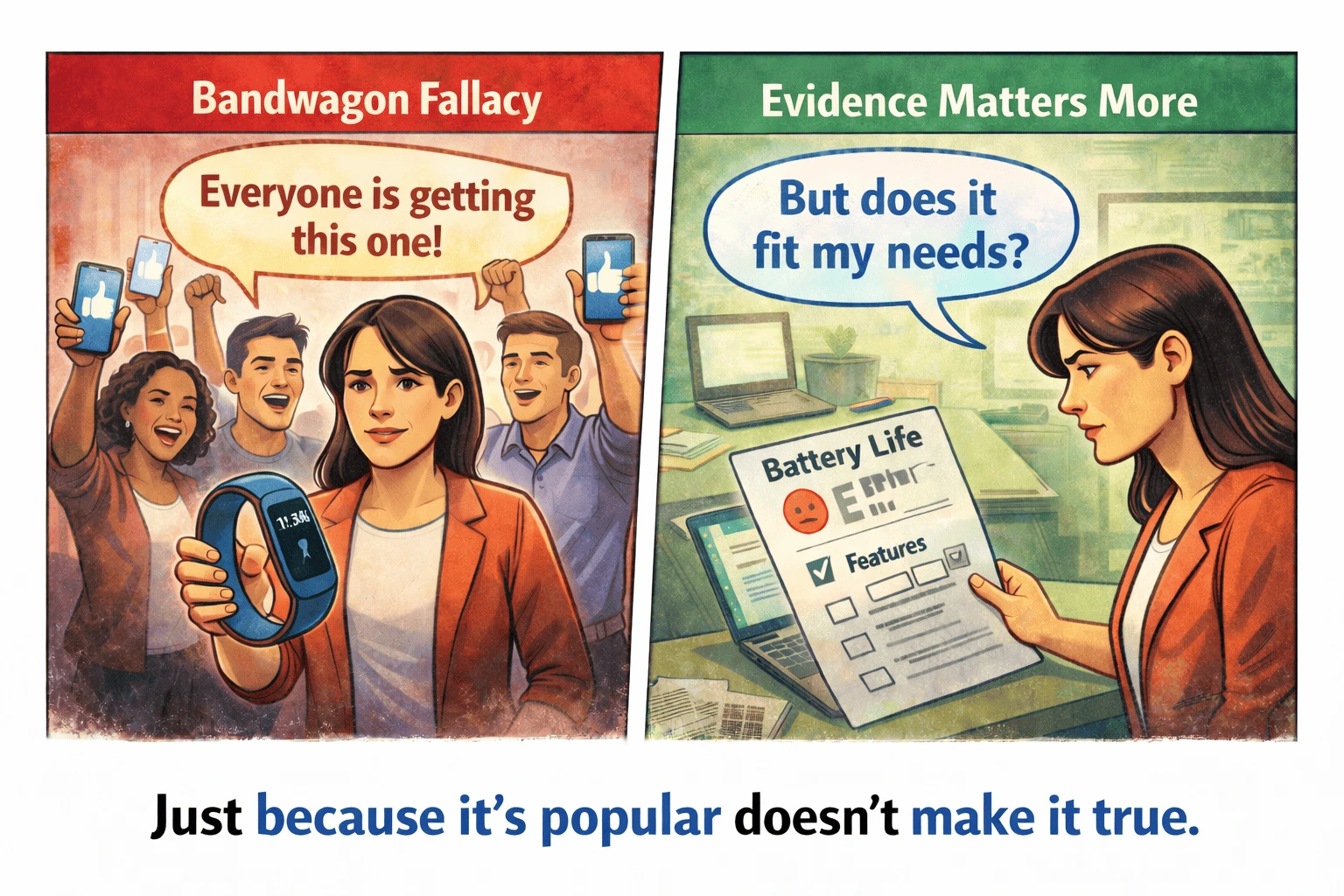
Sara is thinking about buying a new fitness tracker. She’s not sure which one to choose, so she checks reviews and social media.
One model keeps popping up everywhere. Influencers are using it. Her friends are talking about it. It’s all over her feed.
At lunch, someone says:
“Everyone is buying this one. It has to be the best.”
Sara feels the pressure. If everyone likes it, choosing something else feels risky. So she buys it—without really checking whether it fits her needs.
A week later, she realizes the battery life is terrible for her usage and half the features don’t matter to her.
The product wasn’t good or bad because it was popular. But popularity is what made the decision feel “obvious.”
That’s the bandwagon fallacy in action.
Why Our Brain Falls for It
Because being with the crowd feels safe—and for most of human history, it was.
If your whole group suddenly ran, the survivors were the ones who ran first and asked questions later. Following the majority was a life-saving default long before it was a marketing strategy. Your brain inherited that default.
Agreeing with many people:
- Reduces the fear of being wrong (shared mistakes feel less embarrassing)
- Saves time on thinking and comparing
- Feels socially comfortable—dissent has a real cost
- Feels like a shortcut to the “right” answer
Social media pours fuel on all of it. Like counts, trending tabs, view counters—popularity used to be something you sensed vaguely. Now it’s quantified, visible, and refreshed every second, which makes the crowd feel bigger and more unanimous than it really is.
That’s also why the bandwagon pairs so naturally with appeal to emotion: the fear of missing out is the emotional engine, and “everyone’s already on board” is the logical-sounding excuse. You’ll spot it alongside the appeal to authority too (“experts say so”). Different tricks, same result: less thinking, more following.
Everyday Bandwagon Fallacy Examples
You’ll hear this kind of reasoning everywhere:
“Everyone is switching to this app, so it must be better.”
“This opinion has millions of likes, so it’s clearly right.”
“All successful companies do this, so we should too.”
“Nobody I know disagrees, so there’s probably no real problem with it.”
“It’s the best-seller in its category. Case closed.”
In each case, popularity replaces evidence.
And notice the fourth one: “nobody I know disagrees” is the bandwagon riding on a tiny, unrepresentative crowd—a close cousin of the hasty generalization.
Bandwagon vs. Social Proof: When Popularity Actually Matters
Here’s the nuance most explanations skip: popularity isn’t always irrelevant. The trick is knowing what kind of question you’re asking.
For factual claims, popularity is weak evidence at best. Whether a medicine works, whether a headline is accurate, whether an investment is sound—reality doesn’t check the poll numbers before deciding what’s true.
But for some questions, what other people do is exactly the right input:
- Coordination problems. Which side of the road should you drive on? The only correct answer is: the side everyone else uses. Popularity isn’t a shortcut here—it’s the entire point.
- Taste and convention. A restaurant packed with locals is a real (if imperfect) signal. When the question is preference, other people’s preferences are relevant data.
- Network-value products. A messaging app is genuinely more useful because your friends are on it. The popularity is part of the product.
| Question type | Does popularity count as evidence? | | --- | --- | | Factual claims (“Is this true?”) | No—truth isn’t decided by vote | | Quality claims (“Does this work?”) | Weak clue at best—check the actual evidence | | Coordination (“Which side of the road?”) | Yes—matching everyone else is the whole point | | Taste and convention (“Is this restaurant good?”) | A reasonable signal, worth weighing | | Network products (“Which app should I join?”) | Partly yes—popularity adds real value |
So don’t ask, “Is popularity ever relevant?” Ask: “Is this a truth question or a coordination question?”
Bandwagon reasoning fails at the first and works at the second. The fallacy lives in the confusion between them.
Famous Real-World Examples
Tulip mania and the dot-com bubble
In the Dutch Republic of the 1630s, prices for rare tulip bulbs climbed to extraordinary heights—by some accounts, prized bulbs traded for more than a skilled craftsman earned in years—before the market abruptly collapsed in early 1637. Historians still debate how widespread the mania truly was, but it endures as the classic tale of buying a thing because everyone else is buying it.
The same logic returned with modems attached. In the late 1990s, investors piled into internet companies with no profits—often no revenue—largely because everyone around them was doing the same. The NASDAQ peaked in March 2000, then lost most of its value over the following two years as dot-com after dot-com folded.
Every bubble has unique details, but the engine is the same ad populum reasoning: the crowd’s behavior becomes the evidence, and that evidence evaporates the moment the crowd turns around.
The Asch conformity experiments
In the 1950s, psychologist Solomon Asch ran a now-famous series of studies. Participants sat in a small group and answered a trivially easy question: which of three lines matches the length of a reference line?
The catch: everyone else in the room was an actor, coached to give the same obviously wrong answer.
Facing a unanimous group, most participants went along with the clearly false answer at least once, and on average people conformed on roughly a third of the rigged trials. Answering alone, they almost never made a mistake.
That’s the bandwagon effect stripped bare: people overriding the evidence of their own eyes to match the room. It’s the same pressure that drives groupthink in meetings and echo chambers online—except today the “unanimous room” can be a like counter with six digits.
Why It’s a Problem
Popularity tells you what’s common. It doesn’t tell you what’s true, useful, or right for your situation.
The bandwagon fallacy:
- Rewards trends over thinking
- Makes bad ideas spread faster (viral is not the same as verified)
- Pressures people into lazy agreement
- Turns “many people believe this” into “this must be correct”
And it scales viciously. Every person who joins the crowd becomes part of the “evidence” for the next person. That’s exactly how misinformation snowballs online: shares create credibility, and credibility creates more shares—no facts required at any step.
History is full of majorities that were confidently wrong. Popularity measures momentum, not truth. Its close cousin, the appeal to tradition, makes the same move across time: “people have always believed this” is just a bandwagon with ancestors on it.
When It’s NOT a Fallacy
Precision matters here, because following the crowd is sometimes the rational move:
- Adopting conventions. Driving on the local side of the road, using standard units, showing up when invitations say to. These are coordination problems—matching the majority is the correct answer, not a lapse in logic.
- Using popularity as a starting filter. Picking a widely used, well-reviewed product as your shortlist isn’t fallacious—as long as popularity opens the investigation instead of closing it.
- Weighing expert consensus. When most specialists in a field agree, that agreement usually summarizes mountains of evidence. Counting people in a position to know is very different from counting everyone with a keyboard.
The line is simple. Popularity as a clue to investigate: fine. Popularity as the proof itself: fallacy.
How to Spot (and Avoid) It
When you hear:
“Everyone thinks this…” “Most people agree…” “It’s trending, so…”
Pause and ask:
“Okay—but what’s the actual evidence?”
Then run three quick checks:
- Sort the question. Is this a truth problem or a coordination problem?
- Shrink the crowd. Would the claim still convince you if only three people believed it?
- Ask what the crowd knows. Are these people in a position to know—or just repeating each other?
A good decision or argument should still make sense even if fewer people believed it.
How to Respond
When someone leans on the crowd, stay curious instead of combative:
“It’s definitely popular—but is there evidence behind it, or is it popular because it’s popular?”
“Majorities have been wrong plenty of times. What convinced you, apart from everyone else agreeing?”
“You might be right! I’d just rather check the reasons than the like count.”
Each one concedes the popularity (which is real) while gently separating it from the truth (which is the actual question).
The bandwagon fallacy thrives where crowds are visible—and no crowd is more visible than social media. Train your eye with our logical fallacy quiz, then play Daily News, where you hunt reasoning errors buried in realistic reporting. Once you know the shape of “everyone agrees, so…”, you’ll start spotting it in your feed daily.
The Takeaway
The bandwagon fallacy happens when we confuse popularity with truth.
Lots of people believing something can tell you it’s common. It can’t tell you it’s correct.
Popularity is a fine answer to “What is everyone doing?” It’s a terrible answer to “What is true?”
So build the habit:
Don’t ask, “How many people believe this?” Ask, “Why should I believe this?”